Fostering Community Through Third Spaces
Understanding the importance and growing demand of community-centered places
By Katie Blais
Story highlights:
* The term third space, first coined by Ray Oldenburg, highlights spaces that foster community and conversation.
* From ancient Chinese tea houses and 17th-century English coffeehouses to modern-day cafes and libraries, third spaces have been around for centuries, evolving and growing throughout history.
* Coffee shops, libraries, parks, and community gardens are just a few examples of third spaces.
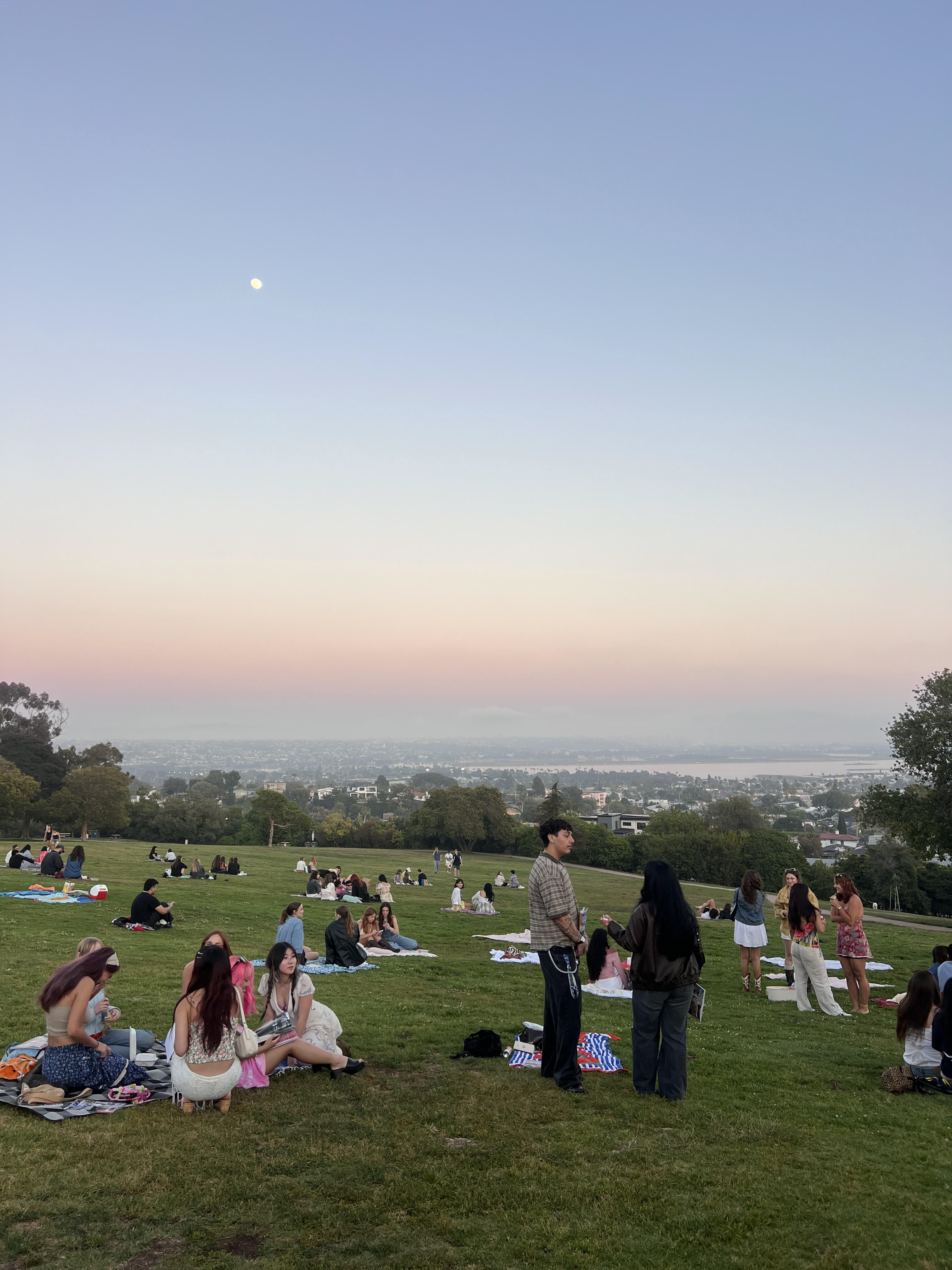
People conversing at Kate Sessions Park in Pacific Beach at sunset on May 9, 2025. Photo Credit: Katie Blais
SAN DIEGO - In our hustle and bustle world, finding community spaces that are relaxed, comfortable and friendly can be challenging, but as interest for community grows, so does the need for third spaces.
“Sun streaming through tall windows, steam rising from fat china mugs, the fragrance of roasted beans and fresh yeasty rolls, and the steady background sound of conversations, laughter and cups clinking. This is where friends meet, where neighbours share news, where business is done, where strangers start talking. This is a third place,” according to an article written for the UNESCO Courier by sociologist Ray Oldenburg and Karen Christensen.
While the term “third space” has recently gained popularity, the places that resemble the term have been around for centuries. The term, first coined by Oldenburg in 1989, defines third spaces in its simplest form as a place outside of your home (first place) and work (second place).
At its core, though, third spaces are a bit more complex and multidimensional. In the article written by Oldenburg and Christensen for the UNESCO Courier, the authors dive into why third spaces are special:
“The third place is not home and not work, but instead one of the physical settings that have throughout history encouraged a sense of warmth, conviviality and that special kind of human sustenance we call community. These settings include cafés, taverns, libraries and hair salons, where people from different walks of life gather to hang out in an informal atmosphere.”
While third spaces encompass a multitude of different places and people, they are united by a common goal: creating community, fostering conversation and providing a safe space for many. Third spaces are more than just a place to grab a quick cup of coffee; they serve as community hubs that are accessible and affordable to the masses, allowing individuals to linger, converse, laugh and lounge. Simply put, third spaces provide something special; they provide a feeling of belonging.
“I love to go to coffee shops; I am inspired by them. Just being there makes me feel really good,” said bookseller Mary Lyons, when asked about her favorite types of third spaces.
What makes a place a third space?
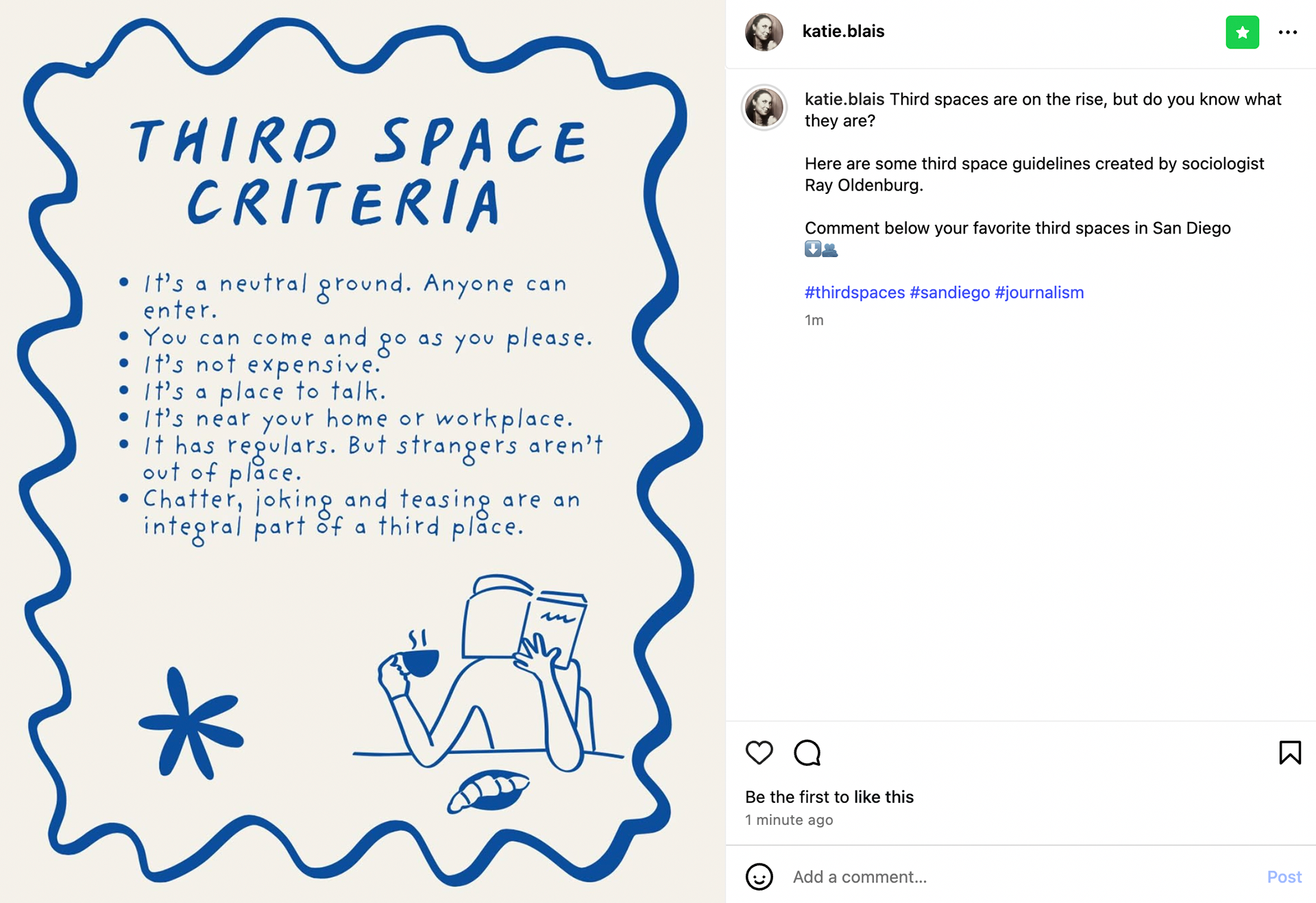
It’s clear that third spaces are centered around community, but you may be wondering - on a technical level - what makes a place a third space? Here are the third space guidelines created by Oldenburg to better understand the general criteria for a third space.
Understanding how third spaces improve individuals' well-being
In an article written by Kaela Girod and Kimberly Burrowes for the Urban Institute, the authors explore how third spaces contribute to thriving communities. According to the article, building robust social networks significantly improves a person’s mental and physical health, and having access to public third spaces allows these networks to flourish.
Girod and Burrowes explored how a recent decline of third spaces can be connected to the rising loneliness epidemic across the country. Without established community hubs, many people have fewer opportunities to connect with their peers, engage in civic responsibilities and find purpose within their community.
Third spaces allow individuals to create social and support networks, both big and small. From having the barista know your order to getting personalized recommendations at your local bookstore, these small interactions can improve a person’s mental well-being simply because they feel seen by members of their community.
In a recent article written for Northeast Psychological Wellness, third spaces are explored from a wellness perspective, highlighting how community-centered places can improve an individual's well-being. Third Places can combat loneliness, improve mood and reduce stress because of their comfortable, social and relaxed character, according to the article.
In a recent article written for Northeast Psychological Wellness, third spaces are explored from a wellness perspective, highlighting how community-centered places can improve an individual's well-being. Third Places can combat loneliness, improve mood and reduce stress because of their comfortable, social and relaxed character, according to the article.
Third spaces also provide a sense of purpose and identity through the opportunities they offer community members, such as volunteering or engaging in a new hobby. The article goes on to explore how third spaces facilitate self-actualization and physical activity while simultaneously combating the negative effects of social isolation. These benefits encourage better physical and mental health, according to their website.
Navigating San Diego’s Third Space Scene
In San Diego, community-centered spaces are rapidly growing and evolving. The city boasts an impressive coffee scene, beautiful outdoor spaces - including Kate Sessions and Balboa Park - as well as quaint bookstores and libraries, and numerous other communal areas. Aside from physical places, community-centered groups have also paved a path for themselves within the third space community.
A peek into the world of Bluestocking Books
Mary Lyons has been a bookseller at Bluestocking Books in Hillcrest for over 20 years. She believes that bookstores can be a vital third space for many communities.
“Sometimes I see two people who don’t know each other, and they talk about a book that they love, and it's very much a place where it’s okay to do that,” said Lyons.
Lyons isn’t the only one who believes that bookstores serve as important third spaces. In an article written for Book Riot, author Susie Dumond explores how bookstores and libraries can serve as the glue that holds a community together.
“Book-centric places are always about more than the books. They are centers for community, spaces for learning and deep conversation, room for joy and play, homes away from home,” said Dumond.
Lyons refers to Bluestocking as a community of book lovers, where conversations among strangers and friends are not only usual, but more importantly, welcomed.
“Our store is like its own little person,” said Lyons.
While the eclectic space has been around since 1967, the current owner, Kris Nelson, bought the store in 1999, when it then became Bluestocking Books. The store sells new and used books and enjoys connecting with visitors from all over the world.
“Bluestocking Books is a sanctuary from the hustle and bustle of the modern world where old (and not so old) titles are waiting on the shelves to choose you,” according to their website.
Lyons believes that many people lack in-person multidimensional connections in their day-to-day lives. Having meaningful conversations, even if they only last a couple of minutes, can make a person’s day.
While chatter among strangers contributes to the welcoming atmosphere of Bluestocking, throughout Lyons’s 20 years of bookselling, she’s been able to truly connect with many customers, whom she now calls friends.
“You get to know someone on a fundamental level,” said Lyons. “I see people that I know, and I know what type of books they like.”
For Lyons, knowing customers' book preferences feels special and genuine. Even though it may seem small, it’s about building a community of people who understand you, even if it's in the simplest form.
While the store serves as a “chapel of books” for many, it’s not always easy being an independent bookstore in today’s growing online economy. Lyons is grateful to each customer who comes through the doors and chooses to shop local.
Third spaces are intended to be affordable and accessible to the masses. Bluestocking offers a used book trade-in program where customers are encouraged to bring in their old books in exchange for credits that can be put towards future purchases, helping maintain an affordable space for all.
Another avenue to explore when considering book-centered third spaces is your local library. The San Diego County Library has 33 branches that offer San Diego County residents a physical and virtual hub of education, entertainment and culture, according to their website.
Oftentimes, libraries encompass the perfect framework to become a thriving third space. Libraries provide an accessible and neutral environment for the community that they serve and allow individuals the opportunity to socialize, learn and connect with others. Aside from the obvious benefits of free and accessible learning, libraries have begun offering a variety of other resources and programs, shifting to a community-centered focus.
While cozy bookstores and libraries serve as critical third spaces for community and conversation, let’s take a look at third spaces bringing their community outside.
Creating a community outdoors
When you think of community gardens, fresh produce and time spent outside may be what you think of first. However, community gardens also play a vital role in a community's well-being; through outdoor education and a space for diverse conversation, these green spaces may be the newest communal hubs.
There are over 80 community gardens in San Diego, according to a database from the Master Gardener Association of San Diego County, and almost 30,000 estimated community gardens across the country, according to the American College of Sports Medicine.
For Carol Beuhler, gardening is an outlet where she finds community and peaceful solitude simultaneously. Beuhler, who is a board member at the College Area Community Garden, considers the garden to be her third space.
“It’s really a great communal space for everybody,” Beuhler said.
The garden serves the greater College Area community with its outdoor green space, monthly volunteer events and workshops that focus on sustainability and composting. At the heart of the garden is a mission to serve its community.
The garden’s Cooperative Growing Program, which donates a portion of the garden’s produce to nonprofit food distributors such as the San Diego Food Bank and The Wesley House, helps those in need, according to the garden’s website.
The garden also allows outside groups to host events, contributing to the communal atmosphere. From book clubs and art groups to a wedding between two gardeners, the garden has become a third space for many individuals.
While the garden does require a membership for gardeners, a leased lot costs roughly $9 a month, maintaining an affordable approach to healthy eating and community gathering.
“We can help sponsor a bin if people don’t have the financial ability to pay,” Beuhler said.
The College Area Community Garden is just one example of an outdoor space that centers community gathering.
A look back at the past
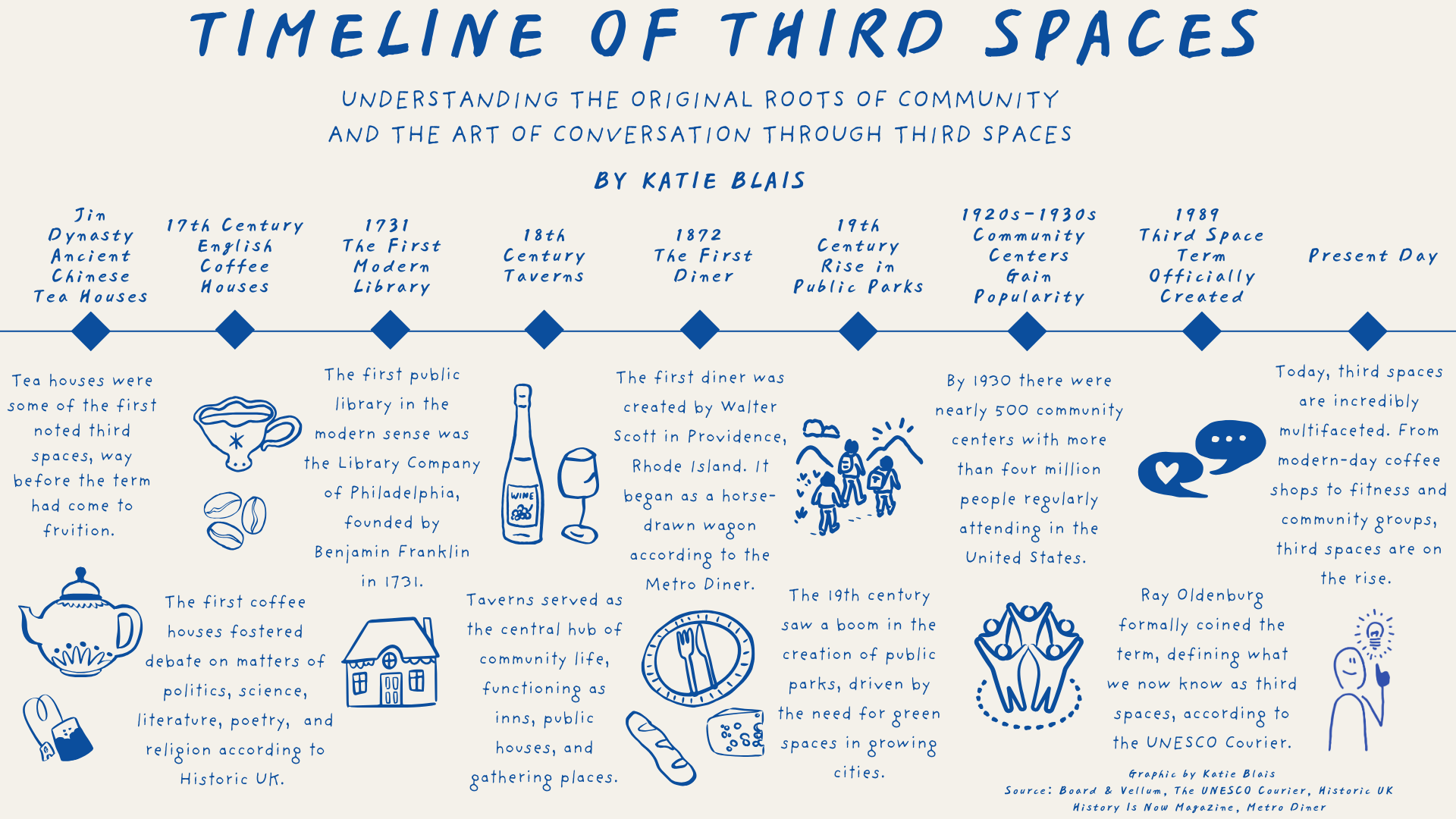
Graphic by Katie Blais
Sources: Board & Vellum, The UNESCO Courier, Historic UK, History Is Now Magazine, Metro Diner
The timeline of third spaces is vast and multifaceted. While the third spaces of the past may look different from the community hubs we’re accustomed to today, they paved the way for community gatherings, casual conversations and civic engagement in the way we now know it.
Some of the earliest known examples of a third space in history are the ancient Chinese teahouses that emerged during the Jin Dynasty. These teahouses served as a meeting place for celebrations, political and philosophical conversations and business discussions. Today, Chinese teahouses still play a vital role in the country’s culture and celebrate community and heritage simultaneously.
English coffee houses of the 17th century also served as an early third space. According to an article written by Ben Johnson for Historic UK, coffee houses fostered conversation in many forms. Coffee-goers would debate politics, science, literature, poetry, commerce and religion, so much so that London coffeehouses became known as “penny universities,” as that was the price of a cup of coffee.
While these places served as respected communal hubs, exclusion often occurred due to the societal expectations and gender roles of the time. As society progressed, community-centered places slowly became more acceptable and accessible.
Throughout history, third spaces have grown and evolved in many ways. While tea and coffee houses were some of the first noted third spaces in history, today there are many more examples of third spaces that are integrated into our communities, helping individuals create robust social networks.